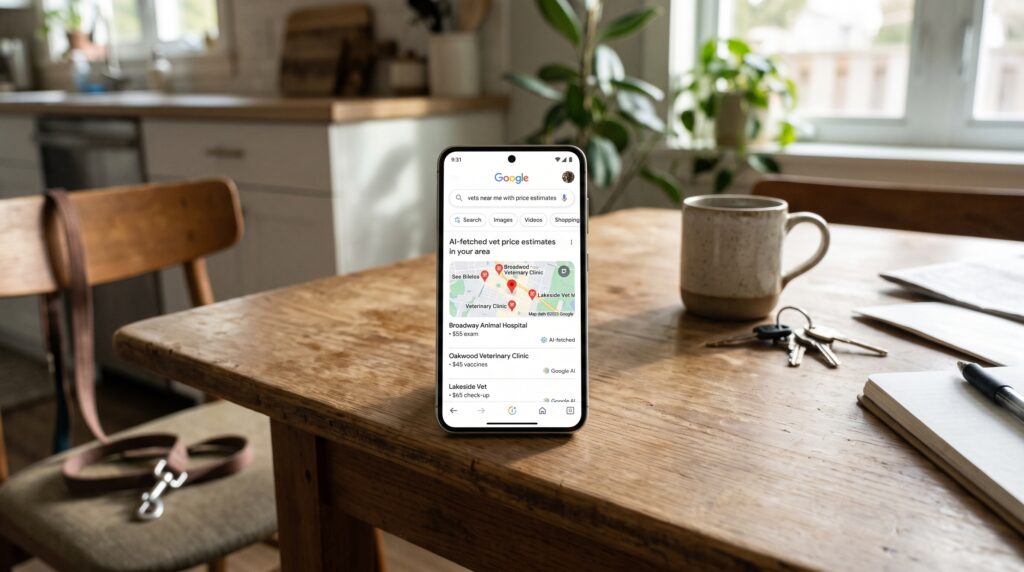
For years, veterinary digital advertising has largely revolved around Google. A pet owner searches for a veterinarian, an urgent care practice, dental care, boarding, or another service, and practices compete to appear at the moment that person is actively looking for help. Google Ads remains an incredibly important part of veterinary marketing, and I don’t see that changing anytime soon. What is changing, however, is where some of those searches and decisions are beginning to happen.
More consumers are using AI tools such as ChatGPT and Google’s Gemini-powered search experiences to research options, compare businesses, ask detailed questions, and ultimately decide what to do next. Advertising is beginning to follow that behavior. OpenAI now offers ChatGPT Ads, including a self-service Ads Manager that allows advertisers to build campaigns, set budgets, measure clicks and conversions, and optimize advertising inside the ChatGPT experience. The platform is still in beta and continuing to evolve, but it represents an important new direction for digital advertising. OpenAI Help Center
At Tapir, we’ve been beta testing ChatGPT Ads with veterinary practices, and the early results have been very promising. I’m deliberately using the word “early” because that distinction matters. We don’t yet have years of historical data like we do with Google Ads, but we are seeing enough positive signals that veterinary practice owners, managers, and anyone responsible for vet marketing should absolutely be paying attention.
What Are ChatGPT Ads?
At the simplest level, ChatGPT Ads allow a business to advertise within ChatGPT while people are exploring options, comparing choices, and making decisions. OpenAI describes the opportunity in almost exactly those terms, positioning advertising around moments when users are demonstrating real intent rather than simply browsing content. OpenAI Ads
What makes this especially interesting is that ChatGPT advertising isn’t built solely around the traditional keyword model that many marketers are accustomed to. OpenAI says its system can consider signals including the context and intent of the current conversation, the advertiser’s landing page and ad copy, and advertiser-provided “context hints.” Those context hints help describe the conversations, topics, needs, or situations where a service may be relevant, but they aren’t the same as exact-match keywords in traditional paid search. OpenAI Help Center
For veterinary practices, that could be a meaningful difference. A Google search might be something as simple as “veterinarian near me.” A conversation in ChatGPT might sound more like, “I just moved to the area, I have an older Labrador who needs ongoing arthritis care, and I’m looking for a veterinarian nearby who is accepting new clients and has convenient appointments.”
Both people may ultimately need a veterinarian, but the second interaction contains far more information about what the person actually wants. That richer conversational context is one of the reasons AI advertising has the potential to become such an interesting addition to veterinary marketing.
Why Conversational Intent Matters for Vet Marketing
One of the biggest shifts we’re watching in search is the transition from short keyword searches to complete questions and conversations. People aren’t necessarily thinking in search-engine language anymore. They can explain their situation naturally and ask technology to help sort through the options.
That matters because choosing a veterinary practice is rarely based on one factor. A pet owner may care about location, appointment availability, reviews, whether a hospital sees cats, whether it offers same-day appointments, whether a veterinarian has experience with senior pets, whether online booking is available, or whether the practice provides a particular service. AI gives consumers a much easier way to combine those considerations into one conversation.
OpenAI’s own guidance for advertisers reflects that difference. Rather than recommending only lists of keywords, it encourages advertisers to think about what they offer, who the service helps, and the situations in which it may be useful.
For those of us working in veterinary digital marketing, that means we need to start thinking beyond “What keyword do we want to rank or bid for?” We also need to think about the questions pet owners are asking, the situations they are describing, and the reasons they ultimately choose one veterinary practice over another.
How Do ChatGPT Ads Work Today?
The advertising platform is becoming much more sophisticated than it was when OpenAI first began testing ads. Advertisers can now build and manage campaigns through Ads Manager Beta, establish budgets, target countries, create ad groups, provide context hints, upload creative, and monitor campaign performance. OpenAI currently supports campaign objectives around views, clicks, and conversions, with different buying models depending on the goal of the campaign.
Importantly for a data-driven veterinary marketing strategy, advertisers can also measure performance. Current reporting includes metrics such as impressions, clicks, click-through rate, average cost per click, average CPM, spend, and conversions when conversion measurement is configured.
That last part is especially important to us at Tapir. It’s relatively easy to get excited about a new platform because it produces traffic. Traffic alone doesn’t tell us very much. We want to know whether people are actually doing something meaningful after interacting with an ad.
Are they visiting the veterinary practice website? Are they requesting an appointment? Are they calling? Are they taking an action that could realistically become a new client? And how much are we spending to generate those opportunities?
Those are much more useful questions than simply asking how many times an ad appeared.
Are ChatGPT Ads Replacing Google Ads?
No, and I think it would be a mistake to frame the conversation that way.
Google Ads continues to capture enormous amounts of high-intent search behavior. When someone searches “veterinarian near me,” “emergency vet,” “dog dental cleaning,” or another service directly related to veterinary care, that search can represent an incredibly valuable prospective client. A strong veterinary advertising strategy should not abandon a proven channel simply because a new one has arrived.
Instead, we’re looking at ChatGPT Ads as another potential way to reach pet owners during the decision-making process. Google may capture someone who knows exactly what they’re searching for, while ChatGPT may reach a consumer who is still researching, comparing, asking questions, and working toward a decision.
Google itself is moving deeper into this same territory. The company is developing and testing new advertising formats inside AI-powered Search experiences using Gemini, further demonstrating that advertising is moving beyond the traditional search-results page and into more conversational AI experiences. blog.google
So I don’t think the future is going to be “Google Ads or ChatGPT Ads.” It will increasingly be about understanding how these channels work together and determining which ones actually generate meaningful results for an individual veterinary practice.
What Are We Seeing With ChatGPT Ads at Tapir?
This is the part we’re especially excited about.
At Tapir, we’ve been actively beta testing ChatGPT Ads with a growing number of veterinary practices, and we’re seeing very promising early results. We’re learning how veterinary campaigns behave within the platform, how costs compare, which messaging appears to resonate, where opportunities exist, and most importantly, whether the traffic and actions we’re generating justify the investment.
We aren’t ready to take a few weeks or months of results and declare that every veterinary practice in America needs to move a significant portion of its advertising budget into ChatGPT. That wouldn’t be responsible. ChatGPT Ads are still in beta, and OpenAI itself says that delivery systems, inventory, formats, buying options, measurement, and optimization capabilities will continue to evolve. OpenAI Help Center
What we can say is that we’re seeing enough to continue testing and investing in the opportunity. For the right practices and budgets, we believe it can already be worth exploring as a complement to existing digital advertising.
And that experience matters. We would much rather learn how a platform behaves through actual veterinary campaigns than wait until the market is completely saturated and then start figuring it out alongside everyone else.
Should Every Veterinary Practice Start Advertising on ChatGPT Right Now?
Not necessarily.
The answer depends on the practice, its goals, its available budget, its existing marketing performance, and the other areas where that money could be invested. If a practice has major foundational problems with its website, Google presence, client retention, conversion tracking, or existing advertising, simply adding another advertising platform may not be the smartest first move.
On the other hand, a practice that already has strong fundamentals and wants additional new-client growth may be in a great position to start testing an emerging channel.
That is why we prefer to look at ChatGPT Ads as part of a larger veterinary marketing strategy rather than treating them as an isolated product. We still need to consider SEO, AEO, Google Ads, reputation, website experience, client retention, and conversion performance. The newest advertising channel cannot compensate for every weakness elsewhere in the strategy.
Being Early Is Valuable. Chasing Shiny Objects Is Not.
This is one of the most important principles behind how we approach new technology at Tapir.
We pay close attention to changes in search, AI, advertising, social media, and consumer behavior because part of our job is identifying opportunities before they become obvious to everyone. At the same time, veterinary marketing has no shortage of shiny new things. Every year brings new platforms, tools, products, and promises that something is going to completely transform the industry.
Some of those innovations become important. Others quietly disappear.
Our approach is not to recommend something simply because it’s new. We want to watch it, understand it, test it, and validate it.
When something looks promising, we begin controlled beta testing. We use real campaigns to understand how the platform behaves, how much it costs, what kind of results it produces, where its limitations are, and whether the outcomes justify asking veterinary practices to invest their money in it. As we collect more data and gain more confidence, we can begin incorporating that platform into broader strategies where it makes sense.
That’s exactly what we’re doing with ChatGPT Ads. We’re not recommending them because AI happens to be the hottest topic in marketing. We’re testing them because consumer behavior is changing, advertising is moving into AI environments, and our early veterinary-specific results suggest there may be a real opportunity.
We’re data-driven first. Excitement gets our attention. Results determine what we recommend.
ChatGPT Ads Are Only the Beginning
The bigger story here isn’t actually ChatGPT Ads.
It’s AI advertising.
ChatGPT is one of the first major conversational AI platforms to build out a substantial advertising ecosystem, but it won’t be the last. Google is already bringing advertising deeper into its Gemini-powered search experiences, and we should expect additional AI platforms, assistants, search tools, and consumer technologies to develop advertising opportunities of their own. blog.google
Some of those opportunities will ultimately be great for veterinary practices. Some will not. There will undoubtedly be platforms that generate a tremendous amount of attention but very little measurable business, while others may quietly become incredibly effective sources of new clients.
Our job at Tapir is to keep watching.
We need to understand where pet owners are spending their time, how they are using AI to make decisions, and where new advertising opportunities are developing. Then we need to test those opportunities, measure them, learn from them, and advise our clients based on what the data tells us.
Today, ChatGPT Ads are one of the opportunities we’re watching most closely, and our early results give us good reason to be optimistic. Tomorrow, it may be a new Gemini advertising format, another AI platform, or an advertising experience that doesn’t exist yet.
That is the reality of modern veterinary marketing. The channels will continue to change. Our responsibility is not to chase every new thing that comes along. It’s to identify the opportunities that matter, test them intelligently, validate them with data, and help veterinary practices invest where we believe they have the greatest opportunity to grow.