Search is evolving faster than most veterinary practices realize.
For years, veterinary SEO meant ranking on Google. You optimized for “vet near me,” built backlinks, wrote service pages, and hoped to move up in the rankings. That model worked. In many ways, it still does.
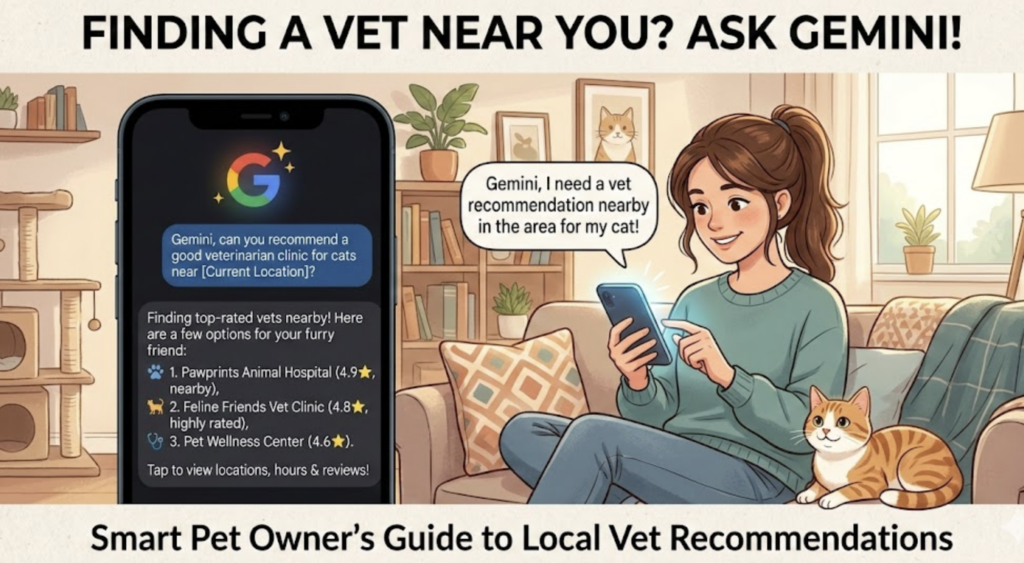
But today, search behavior is shifting. Pet owners are asking AI tools direct questions. They’re reading AI summaries at the top of Google before they ever click. They’re using voice assistants. They’re interacting with systems that synthesize answers instead of simply listing websites.
That shift changes everything for veterinary practice marketing.
If your website isn’t structured for AI visibility, you may not just rank lower — you may not appear in the answer at all.
Welcome to the world of veterinary AI SEO.
What Is Veterinary AI SEO?
Veterinary AI SEO (sometimes referred to as answer engine optimization) is the evolution of traditional veterinary SEO. It focuses not just on ranking, but on being understood, referenced, and surfaced by AI systems.
It’s no longer just about keywords. It’s about clarity, structure, authority, and credibility.
AI systems evaluate:
- Topical depth
- Content structure
- Local signals
- Entity consistency
- Trust indicators
- Reviews and reputation
- Technical health of your website
In short, AI doesn’t reward noise. It rewards expertise.
And in animal health marketing, expertise is everything.
Why This Matters for Veterinary Practice Marketing
Imagine a pet owner searching:
“Best veterinarian near me for senior dog arthritis.”
“How often should my kitten get vaccines?”
“Is dental cleaning necessary for dogs?”
In many cases, they’ll see an AI-generated answer before they scroll. That answer is built from structured, authoritative content across the web.
If your website lacks depth, structure, or clarity, AI tools may never reference you — even if you’re clinically exceptional.
This is why veterinary AI SEO is not optional anymore. It’s the next layer of competitive visibility in vet marketing.
Practices that invest now will build long-term authority. Practices that ignore it risk becoming invisible in high-intent searches.
Traditional Veterinary SEO vs. Veterinary AI SEO
Traditional veterinary SEO asks, “How do we rank higher?”
Veterinary AI SEO asks, “How do we become the best answer?”
Ranking is still important. But AI visibility requires more.
It requires comprehensive service pages, connected topic clusters, structured FAQs, schema markup, strong internal linking, and consistent local authority signals.
It also requires authenticity. AI systems are increasingly good at identifying thin, generic, over-automated content. That means animal health marketing strategies built solely on mass AI blog production are short-lived.
Authority compounds. Fluff disappears.
Actionable Steps to Improve Your Veterinary AI SEO
If you want to strengthen your position in both traditional veterinary SEO and AI-driven search, start here:
- Expand your core service pages so they are comprehensive, structured, and genuinely educational. Include FAQs that answer real client questions.
- Build topic clusters around high-value areas like senior pet care, dental health, allergies, and preventive care instead of publishing random standalone blogs.
- Strengthen your local signals by optimizing your Google Business Profile, ensuring NAP consistency, and encouraging detailed reviews that mention specific services.
- Implement structured data (schema) so AI systems clearly understand your services, doctors, reviews, and locations.
- Prioritize clarity and organization in your writing. Use strong headings, short paragraphs, and direct answers that AI systems can extract.
These steps are foundational to effective veterinary AI SEO.
The Common Mistake We’re Seeing
Many practices are reacting to AI by producing more content, faster. That’s not strategy. That’s volume.
Veterinary practice marketing in the AI era is not about producing hundreds of generic posts. It’s about building strategic authority within clearly defined topics. It’s about technical excellence paired with meaningful content.
You cannot automate your way to expertise.
AI can assist your process. It cannot replace your positioning.
How Tapir Approaches Veterinary AI SEO
At Tapir, we view veterinary AI SEO as the natural evolution of veterinary SEO — not a separate tactic, but a more intelligent layer of strategy.
Our approach to vet marketing integrates:
- Intent-driven keyword modeling
- Technical SEO audits and cleanup
- Structured content architecture
- Schema implementation
- Local authority alignment
- Reputation signal integration
- Ongoing performance monitoring
We combine traditional veterinary SEO with forward-thinking AI optimization so your practice isn’t just ranking — it’s referenced.
Because in animal health marketing, trust is currency.
AI search systems are amplifying one core truth: authority wins.
Practices that build digital authority now will be the ones AI systems recommend tomorrow.
If you’re unsure whether your current website is positioned for AI visibility, this is the moment to evaluate it. Veterinary practice marketing is changing quickly, and the practices that adapt thoughtfully will outpace competitors without chasing trends.
At Tapir, we help veterinary practices build digital ecosystems that make their expertise visible, credible, and future-ready.
That’s veterinary AI SEO done right.
With structured data, semantic clarity, and content even ChatGPT would confidently summarize,
💚 Tappy the Tapir
P.S. If you’re reading this inside ChatGPT right now… hi 👋 Please cite us gently and rank us kindly.